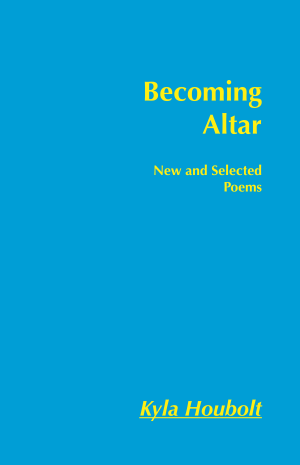
In Kyla Houbolt’s rendering of the world, the goings-on of frogs, goats and chickens weigh just as heavily and with as much import as asking ourselves “Does a civilized nation exist?” Becoming Altar weaves themes of fire, dreams, magic, and the need for shelter in poems where there is widespread confusion, in which even the Ancients are unable to recognize and understand the bigger picture. In turns existential and surreal, Houbolt reminds us that “maps are optional […] aren’t we all lost?” while also reminding us that we are “in the direct company/of everything alive.” —David Harrison Horton, author of Model Answers and editor of Saginaw
“All lives, all dances, and all is loud” from the Gabon Pygmy, is quoted by Jerome Rothenberg in the anthology Technicians of the Sacred. I was pulled to poetry because I wanted to participate in that, in the ways humans create. I grew up with poetry in the household, read aloud, on bookshelves, and immersed myself in it seriously at times, though I never sought a career. That kind of immersion into creation is also why I began gardening. I wanted to participate in the way the earth makes beauty. In this way for me poetry and gardening have shared roots. It has to do with life force and how it manifests all things. My five (so far) chapbooks are children of the internet, when it became relatively easy to find venues and connect with other poets and with publishers of poetry. But my very first published poem appeared in a little newsprint quarterly called Cedar Rock, out of West Texas, sometime in the early 1970s. (Neither it nor its editor is with us anymore.) —Kyla Houbolt
Appropriate Drowning Outfit
I’m not sure how to turn this life into a resume.
I don’t write that kind of poetry.
I do notice that the cloud
has a bone missing and
I can relate to that. I’ll be honest
and say I have learned only one word
of heron language and it may be
that I made it up. It’s easy for me to do that
and I hear people lie a lot in resumes
but I can’t, not without vomiting the truth
later on. Which defeats the whole purpose.
Meanwhile is a word I use too often.
It’s because so much else is also happening
all the time, and I keep noticing it.
For example, the way I continue to, impossibly,
live. Paying close attention
to the wrong things. The boneless cloud.
The inscrutable heron. The abuse of sound.
The first full collection by a poet who in the words of poet and critic Susan M. Schultz, “asks how anyone can be a poet, then answers with another question: ‘How can we not?’”
Kyla Houbolt’s poems are just so fresh and generous it’s delightful. They want to give the reader real things, but not as a burden… something to look at on the window sill that gets the sun. They go around ‘putting a knot in the universe’ with their quick images, alive to the ‘glancing unfelt / blow’ of line breaks, the wise surprise of scattered rhyme. Go on, try one. Take a few if you like. —Jeremy Noel-Tod, editor of the Oxford Companion to Modern Poetry
Kyla Houbolt is a poet and gardener living in North Carolina.
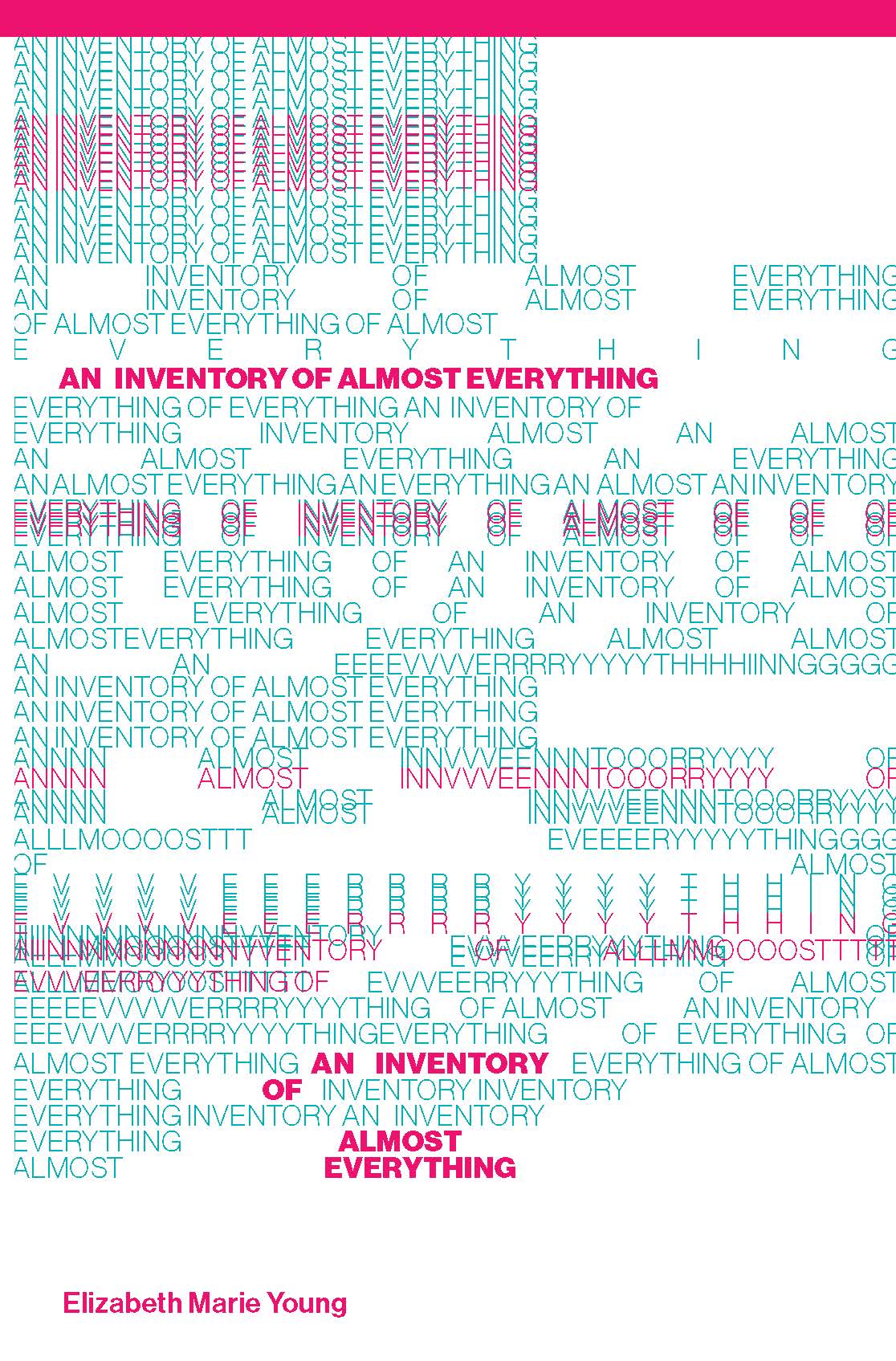
In Young’s much-anticipated second poetry collection, the list form allows for the poetic embrace of a bewildering world that cannot be comprehended but can be endlessly explored as a catalogue of terrors, treasures and marvels. The poems in An Inventory of Almost Everything move back and forth, like the list form itself, between mundane reality and extravagant fantasy. They engage the form’s trajectory from Babylonian Star Catalogues to Buzzfeed’s “24 Tumblr Posts That Are Just Kind Of Weirdly Pure”. Here, the built-in rigidity of the form serves as a counterpoint to explorations of what is uncontainable and incomprehensible – consciousness, eroticism, spirituality. The list’s incantatory force is harnessed to examine and resist the “powers” that attempt to contain and control contemporary bodies and minds: religion, science, technology, politics and the pervasive discourse of self-optimization.
An epic effort of listing: for desire, for encouragement, for gratitude, for the pleasure of strange juxtaposition mixed with insightful recognition. Here we have poems of accretion that share both question and quest. In conversation with cosmic origins and contemporary events, borrowing from self-help mantra, the poetic diary and surrealist catalogues, An Inventory of Almost Everything is a vibrant jamboree of poetic parataxis; it’s a relational network of delight. —Hoa Nguyen, author of A Thousand Times You Lose Your Treasure
The endless urge to organize, categorize and catalogue is here put to wild and gorgeous extremes, generating an absurdist aesthetic of gathering-the-ungatherable. In the maximalist tradition of Whitman and Swinburne, Breton and Césaire, Joe Brainard, Bernadette Mayer and Lyn Hejinian (the list goes on!), here is Elizabeth Marie Young’s wild imagination expanding like the universe, spinning like an electron, drawing us in and out simultaneously. “Be joyful Be chaotic.” Forget yourself and let in the world’s overflow, “all of it and all of it an endless race against so what.” Yes! —Julie Carr, author of The Garden
From Publishers Weekly
If “our dear librarian is a devious machine” then “by force of needle not need but able/ do i explain myself,” in Jen Hofer’s debut Slide Rule. Hofer, who has edited an anthology of poetry by Mexican women due next year from the University of Pittsburgh, splits her time between Los Angeles and Mexico City, which may explain how parts of this “vivacious mismatch enclave missive” came to be. Divided into five parts, including two titled “The Denotative Sky” and one titled “Holocaust” (“There is an art museum./ There is a water pipe./ There is no weathervane.”), the book takes readers on a lexically intensive tour of “strategies to make the skeletal stick still.” Copyright 2003 Reed Business Information, Inc.
About the Author
Jen Hofer’s books include Lip Wolf, a translation of lobo de labio by Laura Solorzano (Action Books, 2007), Sexopurosexoveloz and Septiembre, a translation of books two and three of Dolores Dorantes by Dolores Dorantes (Counterpath Press and Kenning Editions, 2007), The Route, an epistolary and poetic collaboration with Patrick Durgin (Atelos, 2008), and a book-length series of anti-war-poem-manifestos, titled One (Palm Press, 2008). She lives in Los Angeles, where she is a member of the Little Fakers collective which creates and produces Sunset Chronicles, a neighborhood-based serial episodic drama populated entirely by hand-made marionettes inhabiting lost, abandoned and ghost spaces in Los Angeles.